
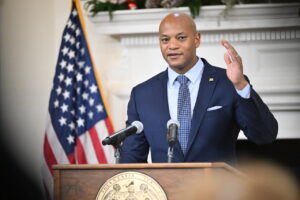
Annapolis, MD — Governor Wes Moore today signed the “Building an Affordable and Reliable Energy Future” executive order to support energy affordability and accelerate deployment of cost-effective energy solutions. The order directs a whole-of-government approach to address both the projected gap in electricity generation and the rising energy costs that impact Maryland families.
“Over the last few years, utility bills have spiked, and for many Marylanders, energy policy has stopped being technical and started being personal,” said Gov. Moore. “This order addresses the untenable system causing these costs to skyrocket. We are putting affordability and reliability at the center of the conversation to ensure our system works for the people who use it, not just the companies that run it.”
The executive order comes as recent data show that residential energy rates have risen 44% since 2020. By modernizing infrastructure and streamlining permitting, the Moore-Miller Administration aims to secure Maryland’s energy future while maintaining the state’s economic competitiveness through four primary pillars:
- Protecting Ratepayers and Lowering Bills: The executive order directs the Maryland Energy Administration to petition the Public Service Commission to review and hold utility providers accountable to budget billing programs. The review would assess whether current practices adequately protect consumers from unexpected costs, while ensuring that program terms are transparent. To fix grid constraints, the state will implement a regulatory strategy that rewards utilities for speed and affordability, prioritizing lower-cost “Non-Wires Alternatives” over expensive capital infrastructure projects.
- Modernizing the Grid with Advanced Technology: The executive order also directs the Maryland Energy Administration to petition the Public Service Commission to require transmission owners to consider advanced transmission technologies before earning approval for new power line construction. Advanced transmission technologies are designed to increase the capacity and efficiency of existing grid infrastructure, increasing reliability for ratepayers. To accelerate modernization, the Maryland Department of Transportation will identify state-owned rights-of-way, such as highway medians, that are suitable for high-voltage transmission and battery storage projects.
- Building Faster and Smarter: To help accelerate the deployment of new energy systems, the state is launching the Maryland Energy Site-Readiness Initiative. The program will publish a “Smart Siting Inventory” by late 2027 with pre-vetted land for energy projects, prioritizing disturbed lands like brownfields and industrial zones over green space. To attract investment to these sites, the Maryland Department of Commerce will assemble “Development Offer Packages” that bundle state resources—including targeted grant funding and technical assistance—to ensure Maryland remains a competitive destination for energy producers.
- Establishing Clear Leadership: The executive order also establishes an energy subcabinet chaired by the Director of the Maryland Energy Administration, which will work to align state resources and oversee the implementation of Maryland’s energy goals. Additionally, a new Maryland Energy Advisory Council will bring together external stakeholders, including utilities, labor, and consumer advocates, to identify deployment barriers. This council is tasked with submitting a formal memorandum within 180 days to identify the most urgent challenges to energy affordability and reliability facing the state.
The signing of today’s executive order builds upon a year of historic action by the Moore-Miller Administration to lower energy costs for Maryland families and businesses. Earlier this year, Governor Moore and Maryland General Assembly leadership enacted the Next Generation Energy Act, a landmark legislative package that authorized $200 million in direct electricity bill rebates for Maryland ratepayers. These rebates, funded through the state’s Strategic Energy Investment Fund, provide relief across two phases. The first phase was applied this past summer, with a second installment scheduled for early 2026. Additionally, in response to the federal government shutdown, Governor Moore deployed $10 million to maintain critical energy assistance benefits.
In addition to direct rebates, the Moore-Miller Administration has invested more than $130 million into clean energy and modernization programs in 2025 alone. The investments include $64 million for county and local government energy modernization, $53 million in funding for the Decarbonizing Public Schools Program, and $17 million to help income-qualified Marylanders access solar power. The initiatives represent a comprehensive strategy to lower bills through increased supply, enhanced grid resilience, and direct financial relief for the Maryland families most in need.