

A bill that would prevent grocery stores from changing prices from one shopper to the next through “dynamic pricing” may backfire by prohibiting stores from issuing targeted discounts and promotions, retail lobbyists warned lawmakers Tuesday.
It’s one of several concerns raised during a bill hearing for Senate Bill 387, a measure backed by the governor and legislative leaders that would ban dynamic pricing at grocery stores.
“Retailers strongly support the principle that consumer data should not be used to raise prices. Full stop,” Cailey Locklair, president of the Maryland Retailers Alliance, told the Senate Finance Committee Tuesday. “But this bill goes well beyond that.”
“In practice, it limits the retailer’s ability to use consumer data to lower prices, even with a narrow loyalty exemption,” she said.
As Marylanders continue to see rising grocery costs, state and national lawmakers worry that the growing use of electronic shelf labels lets grocery stores change prices at any time, leading to concerns of price gouging or even charging individuals differently based on collection of their personal data. Blocking that is one of Gov. Wes Moore’s (D) priority bills.
“Price manipulation that we are seeing in our supermarkets is something that we know is there and is present. And it’s something that we can actually do something about,” Moore told lawmakers, during rare testimony on the bill.
He told lawmakers food retailers in Maryland may be adjusting prices based on a shopper’s individual buying habits and other personal data, asking committee members to support his legislation to ban stores from doing so.

“This legislation requires transparency and fairness inside of our marketplace,” Moore said. “It’s basically saying we should not let … prices be adjusted based on people’s situations.”
The emergency legislation, known as the Protection From Predatory Pricing Act, also has the support of Senate President Bill Ferguson (D-Baltimore City) and House Speaker Joseline Peña-Melnyk (D-Prince George’s and Anne Arundel).
The bill would prohibit “dynamic pricing” defined in the legislation as “the practice of varying prices of consumer goods or services within a business day based on demand or other factors, including through the use of artificial intelligence or models that retrain or recalibrate based on received information in real-time.”
The legislation would prohibit food retailers from using “surveillance data” to collect information on a “consumer’s behavior, characteristics, location or other personal attributes” to set prices for an individual or a group of people.
The bill has an exemption for loyalty programs and promotions, but Locklair is concerned that it’s not enough to ensure that companies are able to provide discounts with the legislation’s broad definitions. Michael Adams, also with the Maryland Retailers Alliance, added that the sort of dynamic pricing targeted in the bill, which is aimed at individuals or groups, would already be covered under the state’s consumer protection laws.
“Retailers use data to deliver data-driven discounts, not price increases,” Locklair said. “This bill risks eliminating consumer discounts, undermining existing data privacy law and restricting beneficial data use without evidence of harm.”
Before he left the hearing, Moore said he would be willing to adjust the language of the bill to clarify any part that may have unintended consequences.
The scale of dynamic pricing occurring in Maryland is is hard to gauge, administration officials previously said. Locklair insisted that companies with the Retailers Alliance were not engaging in dynamic pricing as described in the bill.
Senate Republicans were also skeptical about whether “dynamic pricing” as described is occurring in Maryland.
“I think this (bill) is a solution looking for a problem,” Senate Minority Leader Stephen S. Hershey (R-Upper Shore) said. “We actually haven’t heard where the problem exists.”
“I just think we’ve got to be real careful,” Sen. Justin Ready (R-Frederick and Carroll) added. “We don’t want anybody being gouged, but at the same time, I think there’s sometimes some illiteracy about how pricing works at large.”
But supporters of the bill argue that even if dynamic pricing is not present in Maryland yet, it’s important to protect against it as technological advancements make data collection easier.
George Slover, with the Center for Democracy and Technology, told lawmakers to “rein it in before it becomes widespread in grocery shopping and elsewhere.”
“Vast amounts of this data are being freely gathered, sorted, processed, traded and sold … to secretly create intimate portraits of consumers, which can be used to size us up for susceptibility to pay extra,” Slover said in virtual testimony. “It’s Adam Smith’s invisible hand being turned against consumers and picking their pocket.
“The technology is readily available and it’s becoming easier to use and more powerful with the advance of artificial intelligence. The temptation to use it will be hard to resist,” he said.
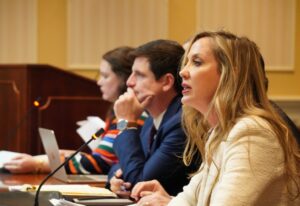
Cailey Locklair, president of the Maryland Retailers Association, testifies against measures in the Protection From Predatory Pricing Act that would ban “dynamic pricing” at grocery stores. (Photo by Danielle J. Brown/Maryland Matters)