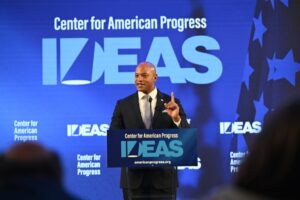
Annapolis, MD — Governor Wes Moore today delivered remarks at the Center for American Progress IDEAS Conference in Washington, D.C., highlighting Maryland’s historic reductions in violent crime and the Moore-Miller Administration’s commitment to an all-of-the-above approach to public safety. Addressing national leaders and policy experts, the governor outlined how record investments in law enforcement, combined with robust initiatives to tackle the root causes of crime, are driving statewide homicides and non-fatal shootings to historic lows.
“We are proving what happens when you reject the false choice between supporting law enforcement and building stronger communities,” said Gov. Moore. “Public safety does not care about politics; it is about results. By getting tough on crime and tough on the root causes of crime, we are delivering historic drops in violence and creating a model for the rest of America.”
Three years into the Moore-Miller Administration, Maryland is experiencing unprecedented declines in violent crime. Statewide homicides have decreased by more than 40%, placing the state on pace for its lowest homicide rate in more than 40 years. Non-fatal shootings have fallen by more than 50%, juvenile homicides are down 39%, and robberies are on track for their lowest totals in decades. In Baltimore, homicides have plummeted by 58%—the lowest rate since the state began keeping records in 1975.
The historic declines are driven by Maryland’s all-of-the-above public safety strategy, which pairs record investments in law enforcement with robust efforts to address the root causes of crime. To support law enforcement, the state provided a record $124.1 million in funding for local police this year; hired state lawyers to target violent offenders alongside federal prosecutors; and invested heavily in programs with a track record of success, such as the Maryland Criminal Intelligence Network—which has dismantled more than 3,900 criminal organizations since its inception.
Simultaneously, the administration has strategically invested in community revitalization and opportunity. These efforts include the $70 million ENOUGH initiative to fight childhood poverty, the historic pardoning of 175,000 misdemeanor cannabis convictions, and the launch of the Stronger, Safer Together initiative, which provides coordinated, multi-agency support to families most affected by violence.
Governor Moore’s 2026 CAP IDEAS Conference remarks as delivered:
Neera, I first want to say thank you.
Thank you not just for the introduction, but also for your remarkable leadership and just for the leadership for the Center for American Progress.
It’s not just that ideas matter, but you all continue to show that results matter.
And so I am deeply humbled and honored to be able to be here and to spend a little bit of time talking about something that is fundamental to our sense of belonging and to our sense of community.
And that is the issue of public service and public safety.
I know I learned in this role that when my phone rings in the middle of the night, I’m never about to get good news.
No one ever calls me at 3:00 in the morning and says, “Hey Gov., I got great news for you.”
The things that will break your heart are the things that will wake you up.
And I know that every so often when my phone rings in the middle of the night—and I first saw that in my first year as governor—when I got one of those calls from the Mayor of Baltimore City, Brandon Scott.
And when I heard his voice on the other end, he told me that there had been a mass shooting in Baltimore’s Brooklyn neighborhood.
The more I learned about what happened that night, I learned that not only was it the largest mass shooting in Baltimore’s history.
I also learned that some of the people who pulled the trigger were children.
And I learned that every single one of the victims were children.
Every one of them.
When I went to the hospital to go spend time with people who were just recovering from surgeries—people who doctors were working to save their lives—it was not lost on me that every single one of the people that I visited was a child.
And the thing that mostly got me also was not just the heartbreak of that moment.
But it was also the days and the months that followed that I realized that there was a much bigger tragedy that we could not ignore.
The bigger tragedy that we couldn’t ignore was this.
That in that area, in Baltimore, in Brooklyn, about one in two children are growing up in poverty.
One in two.
And that we’d seen similar numbers in Brooklyn for well over a decade.
And the people in Brooklyn knew it.
That this was an area that was left behind.
And you cannot understand what happened that night without understanding all the nights that came before.
You cannot just simply mourn the micro if you’re not willing to do something about the macro.
And for me, this issue was and continues to be deeply personal because I grew up in a community that was over-policed.
I felt handcuffs on my wrists by the time I was 11 years old.
I lived in a community where we were both scared of the kids with the guns and scared of the police officers with the badge.
That the pitch of a police siren had a different tone depending on what neighborhood that you called home.
And that people should not have to choose between feeling safe in their skin or feeling safe in their communities.
That’s not how things should work.
And so when I took office in 2023, we made a pledge that this was something that we were going to focus in on every single day.
Because if people do not feel safe, they will not come, and if people do not feel safe, they will not stay.
And so as Neera mentioned, Maryland was suffering from an absolute crisis of violence.
But even more dangerous than that crisis of violence, what we saw was that there was a crisis of apathy towards the violence.
That the pain that people in Maryland were feeling was no longer a piercing pain.
It was now a chronic one.
One that people just became accustomed to.
Baltimore was averaging almost a murder a day.
Maryland families did not feel safe.
And people were then being asked to choose between who they support to make sure that our communities were safe.
Do you support law enforcement?
Or do you support building stronger communities?
People were forcing us to pick a side.
And I realized, and I still believe, and I want to be very clear, that oftentimes the ones who are telling us to pick a side on public safety are ones who actually have no desire of actually addressing public safety.
Too often, it’s people who have no interest in strengthening public safety.
Too often, it’s the ones who do not live in the communities who are telling the communities to pick a side.
Too often, it’s people who think this is an ideology or some kind of academic exercise.
Do you know who does not ask you to choose a side?
The people that this is their everyday reality.
The people who actually live in the communities.
So I am clear.
I do not take my talking points when it comes to public safety from a political party or from someone who wants to do an academic exercise about it.
And in the wake of Brooklyn, the state of Maryland decided that we would take a different type of approach.
In the wake of Brooklyn, the state of Maryland decided that we would take an all-of-the-above approach when it came to public safety.
And that all-of-the-above approach would rest on three commitments.
The first commitment was accountability.
The second commitment was intervention—or basically increasing resources to the people who are protecting our communities.
And the third was prevention—and increasing the opportunities for those who are living in the communities where violent crime actually exists in the first place.
First, we focus on accountability.
I’ve been clear that loving and supporting your young people does not mean abandoning accountability.
Accountability is actually how you show support.
This is what our administration passed and signed when it came to making sure that when a child is in trouble and in need, the answer is not just to tell them that it’s okay.
But that accountability must take a holistic form in the way that we are addressing it.
For too long, our system was not holding our young people accountable, and it was not setting them up to be rehabilitated either.
The Juvenile Law Reform Act of 2024 brought together those two things.
Because I believe in second chances.
I am the recipient of second, and third, and eighth, and ninth chances.
But I will not tolerate lawlessness.
And next week, I will sign the Youth Charging Reform Act.
Right now, too many young people in Maryland are automatically charged in adult court.
And they will wait an average of four months before a judge even decides whether their case belongs in adult court or juvenile court.
And in some cases, we’ve got children who are waiting much longer.
85% of those cases ultimately get dismissed or sent back to juvenile court.
But here’s the thing: those months matter.
And that delay matters.
It matters to that child.
It matters to that community.
It matters to that family.
And it matters to the entire system.
Because it means that accountability comes too late.
It means that services to support that child come too late.
It means that we miss that critical window to change behavior and to improve outcomes.
Now, the most serious offenses like murder, and rape, and carjacking—they will stay in adult court as they should.
But for the cases that belong in juvenile court, we are going to act faster and make sure that accountability can actually mean something.
We’re going to deliver accountability faster.
We’re going to make better use of our juvenile system.
We’re going to deliver safer outcomes to the communities across our state.
And we’re going to do it now.
Second, increased intervention and providing support to those who keep us safe.
Today, Maryland is delivering record funding to local law enforcement—over $124 million this year alone.
That’s money for new equipment.
That is money for overtime.
That is money for sustainably backing officers who have been asking for it for years.
I am a deep believer that you can have a law enforcement agency that moves with appropriate intensity, and absolute integrity, and full accountability, and you do not have to compromise on those things.
And that’s money that’s matched by the oversight and accountability that makes sure that every dollar is delivering what it says it’s going to deliver.
And our law enforcement professionals will be expected to follow the highest of standards.
We made a landmark investment in the Baltimore State’s Attorney’s office.
We backed their work of prosecuting violent crime.
We asked them to do something different, which is actually to partner on re-entry programming for people who are coming home.
Because the reality is 95% of people who are incarcerated—they are coming home.
So we must do a better job of both preparing them for re-entry, but also preparing society for their re-entry as well.
That the work of public safety does not end on arrest nor on conviction.
That if you want fewer crimes tomorrow, it means you break the cycle today.
Maryland is now one of the only states in the country that hires state lawyers and partners them inside of the U.S. Attorney’s office.
They work shoulder to shoulder with federal prosecutors to ensure that violent criminals are held accountable.
And to connect federal, and state, and local law enforcement in real time, we have built out the Maryland Criminal Intelligence Network.
Since its inception, it has disrupted more than 3,900 criminal organizations.
It has removed more than 4,800 illegal firearms from our streets.
It has seized nearly $80 million in drugs, in cash, and other assets.
It’s done what it’s intended to do.
Just a few weeks ago, I stood with the Sheriffs of Worcester and Wicomico County.
And for those who don’t know Maryland, Worcester and Wicomico County aren’t necessarily Democratic areas.
These are two rural counties in reliably Republican areas of our state.
These are both counties that I lost by thousands of votes.
But public safety doesn’t care about politics.
It cares about results.
And after a years-long investigation, we dismantled a drug trafficking organization pushing narcotics across the Eastern Shore, and Baltimore, and Pennsylvania, and Virginia, and Delaware.
We brought together 13 federal, state, and local agencies.
We delivered more than 80 search warrants.
We seized more than 42 kilograms of cocaine—one of the largest seizures in the history of Wicomico County.
And we worked together to make sure we didn’t just get the job done, but we sent a message that if we said it, we meant it.
But we also know that delivering intervention doesn’t just mean supporting law enforcement.
Because we’ve also dedicated funding for community violence intervention programs like the Baltimore Safe Streets initiative.
This program deploys credible messengers to provide support for those at risk of committing crime.
It helps to address the issue of retaliatory crime.
Because we know that oftentimes that’s the crime and the violence that we are talking about.
It is retaliatory by nature.
So those who are closest to the community have got to be the ones who are first at the table.
Third, prevention.
We dedicated our time to get tough on the root causes of crime.
In Maryland, nearly half of all drug arrests in the 2000s were for cannabis.
Black Marylanders were three times more likely to be arrested for cannabis than white Marylanders before legalization.
And every one of those misdemeanor convictions was making it harder to get a job, making it harder to find housing, making it harder to start a business, making it harder to come home.
In 2022, our state voted to have a recreational cannabis market.
And so I pledged that we would make sure that the cannabis market was rolled out equitably and safely.
But I also knew that I refused to celebrate the benefits of legalization if we did not also address the consequences of criminalization.
And that’s why in 2024, I signed pardons for more than 175,000 cannabis convictions.
It was the largest mass pardon in the history of the United States of America.
Because you cannot reduce violent crime if you’re not addressing the conditions in the communities where the violence actually exists.
That means investing state resources in a way that will strengthen communities.
By delivering more support for public education.
By building out job training programs and re-entry programs.
By supporting behavioral health.
And by fighting child poverty.
It’s why our administration raised the minimum wage, giving over 160,000 Maryland workers a pay raise bump.
It’s why we have expanded the child tax credit and the earned income tax credit inside of the state of Maryland.
It is why we launched the most ambitious state-led, place-based anti-poverty effort in this country’s history called the ENOUGH initiative.
And by the way, ENOUGH is an acronym—it stands for Engaging Neighborhoods, Organizations, Unions, Governments, and Households.
And the premise of ENOUGH is simple.
Our communities provide the vision, the state, the private sector, and philanthropy provide the support.
And not the other way around, as it’s often done.
We have delivered almost $70 million to 28 communities across our state.
These are urban, rural, and suburban communities.
And these communities have been dealing with the issue of not just concentrated poverty, but generational poverty.
That if you look at the poverty map in 2023, it’s not just that it’s everywhere.
It’s that if you look at the same map in 2013, it looks exactly the same.
Or in 2003.
The only difference is the red areas have just gotten redder.
Concentrated generational poverty.
These areas and communities are now developing their own plans to address poverty in their own communities.
Every dollar that the state has put in through ENOUGH, philanthropy and state agencies have put in three more.
That turns $70 million into nearly $280 million, and the community decides where that capital goes.
If you look at McElderry Park on the east side of Baltimore.
A community organization called Tendea Family used their ENOUGH grant to launch a program called the Drug Free Down Da Hill.
It’s a neighborhood patrol, but not like one that you probably have heard about.
They actually actively find people who are struggling with addiction.
They connect them with recovery, and job training, and housing.
They offer free haircuts, and food, and clothing.
They provide mental health support.
They came up with the idea.
Not the state.
Earlier, I talked about how we strengthened coordination amongst law enforcement to go after people who hurt our community.
But we also strengthened coordination between those who are working to help our communities, too.
Public safety requires violence prevention, direct violence intervention, and maintaining accountability.
And that’s why we created a program called the Thrive Academy that focuses on youth that have the highest probability of either being the victim or the perpetrator of gun violence.
The youth who are going through the most challenges.
And now we’ve seen that nine out of ten participants have not had a gun-related offense post-enrollment.
And for the first time ever, Maryland’s Department of Public Safety, Human Services, and Juvenile Services are working together to integrate violence prevention.
That’s more than 2,000 families concentrated in 14 zip codes across our state that are receiving support.
Communities in Hagerstown in Western Maryland, Salisbury on the Eastern Shore, East Baltimore, Capitol Heights, District Heights in Prince George’s County.
Regardless of your background, we are going to focus on your future.
No matter the obstacles you might have faced, we’re going to provide support and family navigators through our Safer Stronger Together initiative that’s going to focus on your opportunities.
We made sure that high schools are not being evaluated exclusively on their four-year college acceptance rate, because that is an input, but it is not a key performance indicator.
That every single child, whether you head to a four-year college or not, needs to find a pathway to work, and wages, and wealth.
I can say that I’m very proud—I believe I’m one of the only governors in this country that graduated from a two-year college.
I joined the Army when I was 17 years old.
I did not have a traditional background, and things worked out just fine.
And we want to make sure that every single child knows that they can find their pathway, no matter their origin story.
And since 2023, we have more than doubled the number of youth apprentices in our high schools.
Since 2023, we have grown our apprenticeship network to over 1,200 participating employers statewide.
Since 2023, we have partnered with unions and employers to graduate over 5,000 apprentices.
And by the end of my second term, we’ve set our goal to have 4,000 Maryland high schoolers graduating with registered apprenticeships every single year.
The reason I bring that up is this, as I’m coming to a close.
It’s not just what we did.
It’s that results actually matter, too.
That three years after I took office, homicides are down more than 40% statewide.
Non-fatal shootings are down more than 50%.
Juvenile homicides are down 29%.
Robberies are on track to have the lowest number that we have seen in decades.
And the progress is sustainable because while violent crime saw historic drops last year, I know because we are doing our performance cabinets on public safety—and I know for a fact because I had one this morning—that so far this year, homicides are now down statewide over 25% again after historic drops of last year.
Now I know that the President of the United States likes to call Baltimore City a hellhole.
But I have learned that trying to fact-check the President is an exhausting and a completely fruitless exercise.
And frankly, none of us have enough time in our day because we actually want to get real work done.
But he should check his facts here on Baltimore.
And better yet, he should actually come visit Baltimore.
But he should come visit Baltimore not to lecture. He should come visit Baltimore to learn.
If he did, he would learn about the all-of-the-above strategy that Maryland has deployed when it comes to public safety.
He would learn that homicides in Baltimore are now down 58% since I was inaugurated.
He would learn that this past year alone, Baltimore recorded the largest year-over-year drop in homicides ever measured in the city.
The last time the homicide rate was this low in Baltimore City, I was not born yet.
I would love for him to come and learn.
Because he could learn that these results are not an accident.
They are proof of what happens when you reject false choices and you don’t succumb to ideologies.
After Brooklyn, we did not make Maryland safer by militarizing our neighborhoods.
We did not make Maryland safer by calling in the National Guard.
We made Maryland safer despite the fact that the FBI, and the DEA, and the ATF were being pulled off of drug and gun trafficking investigations.
We made Maryland safer by saying our communities do not need us to save them.
We needed to stop passing bad policies that were hurting them.
We needed to allow our communities the space and the grace to save themselves.
We did not have to save Brooklyn.
Brooklyn saved itself.
And that’s why I keep coming back to that night in Brooklyn.
That’s why I keep coming back to Krystal Gonzalez, whose daughter was shot and killed in Brooklyn that night.
And that night, I made her a promise.
That I would never spend my time as governor simply giving thoughts and prayers.
I would not spend my time as governor just simply attending funerals and not passing a single piece of legislation.
I would not spend my time as governor just giving eulogies.
That good government is about making strong choices.
And it’s not about making choices for communities.
It’s about making choices with them.
The President thinks our job is to oversee communities.
I think our job is to actually see communities.
Our job is to leave no one behind.
So God bless you guys, thank you so much.