
Family farmers who raise chickens in Maryland’s chicken community testified in the Maryland General Assembly in support of SB 371/HB 395, which would repeal a requirement that a person hold a concentrated animal feeding operation (CAFO) general discharge permit before the person may begin construction on any part of a chicken farm.
Nearly every chicken farm in Maryland is required to obtain coverage under a Concentrated Animal Feeding Operation (CAFO) permit. The permit is often called a “non-discharge discharge permit” because the law stipulates that to receive coverage, a chicken farm must be designed, constructed, operated, and maintained such that a discharge of manure, litter, or process wastewater will not occur to surface waters. This single general discharge permit is delegated to the Maryland Department of the Environment by the U.S. Environmental Protection Agency and expires every five years, when a renegotiated permit is meant to take effect. In July 2025, the existing CAFO permit expired before MDE had even submitted a new permit for review, which it did in August. Only then did the public comment process on the draft permit begin, and as of February, Maryland still lacks a current CAFO permit for farmers to apply for.
MDE’s interpretation of its permitting authority has been such that farmers (many of them new and beginning) wanting to start operations have been unable to break ground or even obtain financing for their chicken houses, because they have no way to apply for or obtain a CAFO permit. DCA estimates that approximately $35 million in construction projects have been stalled by this de facto moratorium on new chicken house construction in Maryland.
The intent of SB 371/HB 395 is to allow for chicken house construction and financing should the permit once again expire without a renewed permit in effect. This would make it so that during the interim, prospective growers can build their operations and be prepared to receive birds once they’ve been permitted. If this law is passed before the adoption of the permit, it would bring immediate relief to area farmers by allowing them to begin the financing and construction process. These farms would not be operational until they are fully permitted by MDE. No birds would be placed in the chicken house until they receive full coverage. Therefore, this legislation would have no impact on the permitting process or water quality; it does not impact the fundamental environmental protection requirements of chicken farming or MDE’s oversight.
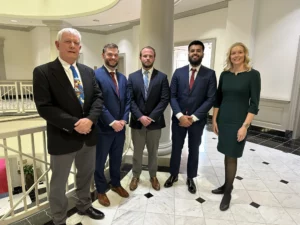
Several chicken growers from family farms on Maryland’s Eastern Shore, who contribute to the state’s $5.4 billion chicken economy, testified in support of the legislation in committee hearings on Feb. 10 and 11.
Waleed Warraich, Wicomico County: “Since early 2025, we have been trying to start another chicken farm to expand our business. Unfortunately, we were told this was not possible due to the unavailability of a CAFO permit. My family, like many others, cannot even obtain financing or start work on stormwater management or building pads due to the current law that prohibits the construction of any part of a CAFO before getting a permit. I’m not here today to ask for special treatment. On our farm, we follow every regulation exactly so that there’s no discharge. This is our livelihood; every day that we cannot start construction, we lose critical income.”
Asif Khan, Dorchester County: “I came to the United States a decade ago, looking forward to a better future for my family. I like farming, not only because I take pride in the work, but because it has enabled me to establish myself as a self-sufficient business owner. I had a farm back in 2024 which I sold in Delaware, and tried to build a new one in Maryland. I bought a piece of land in Dorchester County, and I’ve been going through the process of getting permits, and were told this was not possible due to the unavailability of a CAFO permit… It is extremely frustrating to be told that we cannot go forward with starting our farm and expanding our family’s dream, not because of anything we did, just because of an administrative error.”
Jason Cronshaw, Queen Anne’s County: “We’ve run into a CAFO issue, and that issue has proven pretty difficult. I can’t get any lending to start this process. I hope this bill can get passed, to allow us to be able to build, to move forward, and have the clarity that we need to be able to support our families and our farm operations, so that we don’t ever have to worry about possibly losing that.”
The secretary of the Maryland Department of the Environment, the secretary of the Maryland Department of Agriculture, and leaders from Maryland Farm Bureau, Maryland Grain Producers, Horizon Farm Credit, The Land Group, Marydel Ag Supply, and local real estate agents also gave supportive testimony concerning SB 371/HB 395 to the Maryland General Assembly in committee hearings.
About Delmarva Chicken Association
Delmarva Chicken Association, founded in 1948, has been the Delmarva chicken industry’s voice as the premier membership association focusing on advocacy, education and member relations for more than 75 years. DCA’s vision is to be the most-respected chicken organization in the United States. For more information about the Delmarva Chicken Association, visit www.dcachicken.com or call 302-856-9037.