
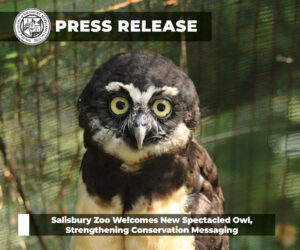
Salisbury, MD — The Salisbury Zoo is pleased to announce the arrival of a new male Spectacled Owl named Bosque — Spanish for “forest.” Bosque, just over 1 year old, has joined the Zoo’s resident female, Luna, age 28. The pair has already exhibited positive affiliative behaviors, making for a smooth and successful introduction focused on social enrichment. Visitors can now see Bosque and Luna on habitat and learn about the species’ role in tropical forest ecosystems.
Spectacled Owls are native to dense, old-growth tropical rainforests from southern Mexico through Central America and into parts of South America. As the largest owl species across much of their range, they serve as apex nocturnal predators and play a significant role in maintaining healthy forest ecosystems. They are easily recognized by the striking white “spectacle” markings encircling their eyes, deep hooting calls, and their remarkable ability to remain completely still while hunting — a behavior that makes them highly effective ambush predators.
The Salisbury Zoo has cared for Spectacled Owls since 1988 and participates in the cooperative management of the species within accredited zoological facilities. Bosque’s arrival was made possible by the recent transfer of a second female owl, formerly housed at the Salisbury Zoo, to a Florida institution. The move created an additional compatible pair, supporting the wellbeing of all owls involved. While reproduction is unlikely due to the age difference, the pair’s introduction provides valuable social enrichment, and any surprises would be a record-breaking delight!
Although Spectacled Owls are currently listed as Least Concern due to stable wild populations, they face growing challenges from habitat loss, degradation, and fragmentation — threats impacting old-growth forests both within their native range and in parts of the United States.
“Bosque and Luna help us share the story of forest ecosystems and why protecting old-growth habitat matters,” said Luke Krider, Animal Collections at the Salisbury Zoo. “By caring for this species, we’re able to build empathy for wildlife and inspire visitors to take meaningful steps that support conservation.”
Through conservation education and species care, the Salisbury Zoo continues its mission to connect people with wildlife and empower the community to play an active role in preserving critical wild spaces.
For more information, please contact the Salisbury Zoo at 410-548-3188 or visit salisburyzoo.org.