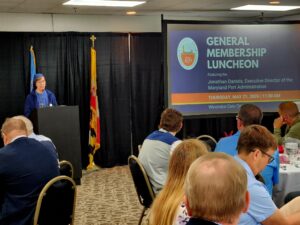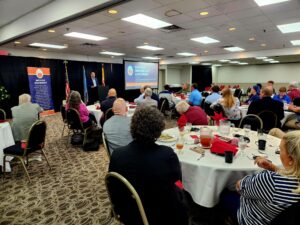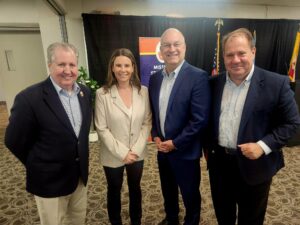
The Salisbury Area Chamber of Commerce (SACC) hosted its May General Membership Luncheon at the Wicomico Civic Center in Salisbury, Maryland. The featured speaker was Jonathan Daniels, Executive Director of the Maryland Port Administration, who shared insights into the Port of Baltimore’s recovery, resilience, and future growth.
Daniels, who was appointed Executive Director in 2023, brought more than three decades of port management experience to the role. He opened his presentation by emphasizing the Port of Baltimore’s critical role in the state’s economy, stating, “The Port of Baltimore is the cornerstone of Maryland’s economic development efforts.”
Only months after Daniels assumed leadership, Maryland faced one of the most significant transportation and economic challenges in its history when the Francis Scott Key Bridge collapse disrupted commerce and transportation throughout the region. Reflecting on that tragic day, Daniels recalled receiving a call from the Maryland Secretary of Transportation at 1:34 a.m.
“I knew at that moment that life would never be the same,” he shared.
Daniels described the extraordinary coordination among federal, state, and local officials that immediately followed the disaster. Recovery efforts focused on four key priorities: supporting and caring for the victims’ families while recovering the victims; reopening the shipping channel as quickly as possible; assisting thousands of impacted and unemployed port workers; and securing state legislative grants to provide financial support for those affected.
Before the Key Bridge disaster, the Port of Baltimore had achieved a record-setting year in 2023. Daniels reported that the port has made a remarkable recovery, with 2025 performance figures showing operations have returned to nearly full capacity. Carriers and shippers have returned in force, making 2025 the second-best year in the port’s history.
He also highlighted the port’s national significance, noting that Baltimore ranks first in the United States for vehicle imports and second for handling commodities such as coal and sugar.
“Presently, the port is dealing with ever-changing tariffs and geopolitical issues occurring around the globe,” Daniels explained.
Looking ahead, Daniels outlined several major infrastructure projects designed to strengthen the port’s competitiveness and support future growth. Construction is underway on a four-acre grain silo that will expand capacity for agricultural exports. He also highlighted the expansion of the Howard Street Tunnel in downtown Baltimore, a project that will allow double-stacked container trains to move significantly more freight from the port to Midwest markets.
“These investments will enhance the port’s ability to move goods efficiently and position Baltimore for continued growth in the years ahead,” Daniels said.
The luncheon provided attendees with a compelling look at the challenges, recovery efforts, and opportunities facing one of Maryland’s most important economic engines.
-
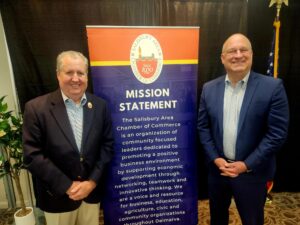
- The SACC President CEO Bill Chambers and Jonathan Daniels, Executive Director of the Maryland Port Administration
-
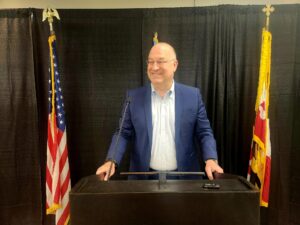
- Jonathan Daniels, Executive Director of the Maryland Port Administration addresses the SACC membership