
Salisbury, MD — Two of the Eastern Shore’s preeminent higher education institutions are partnering in a new way to provide more educational opportunities than ever for students in Wicomico, Worcester, and Somerset counties.
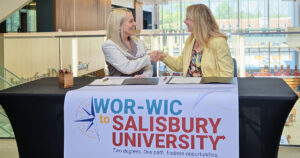
SU President Carolyn Ringer Lepre joined Wor-Wic President Deborah Casey in signing a memorandum of understanding (MOU) to create “Wor-Wic to SU,” a wide-ranging program articulation agreement through the Maryland Transfer Intensive. Starting this fall, the initiative will help ensure a smooth transition for students transferring from the community college to the university in more than 20 academic areas.
“For decades, students have begun their academic journeys at Wor-Wic Community College before continuing at Salisbury University, making transfer students an important and valued part of our campus community,” said Lepre. “This partnership builds on our long-standing relationship and shared commitment to student success by creating even more seamless pathways for students to transfer credits, stay on track toward graduation, and achieve their educational goals.”
“When Wor‑Wic students complete their associate degree and transfer to SU as juniors, they are positioned for greater access, stronger academic success and meaningful career opportunities,” said Casey. “This partnership between our sister institutions reinforces our shared commitment to student achievement and helps build the skilled workforce our region needs to thrive. This collaboration not only empowers students but also strengthens the local workforce that depends on well‑prepared, homegrown talent.”
The partnership is part of the Maryland Transfer Intensive, a multiyear initiative of the Maryland Higher Education Commission and Aspen Institute College Excellence Program designed to significantly improve community college transfer outcomes. While 55% of Maryland community college students are in transfer programs, only 23% transfer to a Maryland four-year institution within six years. Fewer than half complete a bachelor’s degree within three years of
“The Maryland Transfer Intensive’s goal is to offer an affordable pathway for community college students and graduates to earn their bachelor’s degrees at Maryland universities,” said Allen Koehler, SU associate vice president for enrollment management. “Our goal at SU is to make sure Wor-Wic students can do that without leaving the area they call home. We know students who transfer to SU with their associate’s degree earn a higher GPA and graduate at a higher rate, so we want students to earn their degree from Wor-Wic and then earn their bachelor’s degree from SU.”
“At Wor-Wic, our focus is always on removing barriers and providing the holistic support students need to achieve their goals,” said Dr. Michael Hutmaker, vice president for student affairs at Wor-Wic. “By expanding these pathways with Salisbury University, we are ensuring our students have a direct, clear roadmap to their bachelor’s degrees. This partnership allows them to transition smoothly after earning their associate degree and build upon the confidence that their hard work at the community college level will seamlessly carry them through to graduation at SU.”
Under the recently signed MOU, SU and Wor-Wic will maintain its current articulation agreements in engineering, with new or continuing agreements for computer science, mathematics, biology, chemistry, business, psychology, interdisciplinary studies, and secondary education programs in chemistry, mathematics, biology, earth science, physics, and history.
Potential future programs that could be added to the agreement include forensic science, data science, criminal justice, nursing, early childhood education, and secondary education programs in English, Spanish, and French.
In addition to providing a pipeline for students, SU and Wor-Wic officials hope the partnership will be beneficial for local and regional employers seeking to attract and retain talent in key areas. According to the Community College Research Center at Teachers College, Columbia University, and the National Student Clearinghouse Research Center, 88% of community college students stay in their states after they graduate, working and contributing to the local economy.
For more information about the Maryland Transfer Intensive, visit and Aspen Institute College Excellence Program website at https://highered.aspeninstitute.org/programs/state-system-engagement#maryland-transfer-intensive-program.
For more information about Wor-Wic Community College, visit www.worwic.edu.
Learn more about SU and Opportunities to Make Tomorrow Yours at www.salisbury.edu.